nOT MY WALLET, NOT MY COINS


A
Address:
A unique identifier for a cryptocurrency wallet, used to send and receive digital currencies. It’s similar to a bank account number but for blockchain networks.
Example: A Bitcoin address might look like “1A1zP1eP5QGefi2DMPTfTL5SLmv7DivfNa”
Airdrop:
A distribution of free cryptocurrency tokens or coins directly to multiple wallet addresses, often used as a marketing strategy or to decentralize token distribution.
Example: Uniswap airdropped 400 UNI tokens to anyone who had used their platform before a specific date.
Algorithmic Stablecoin:
A type of stablecoin that maintains its peg to another asset through algorithms and smart contracts rather than being backed by collateral.
Example: Terra’s UST was an algorithmic stablecoin that attempted to maintain a $1 value through an algorithmic relationship with the LUNA token.
All-Time High (ATH):
The highest price a cryptocurrency has ever reached in its trading history.
Example: Bitcoin reached an all-time high of nearly $69,000 in November 2021.
All-Time Low (ATL):
The lowest price a cryptocurrency has ever reached in its trading history.
Example: After the 2022 market crash, many cryptocurrencies hit their all-time lows.
Altcoin:
Any cryptocurrency that is not Bitcoin. Alternative coins that emerged after Bitcoin’s creation, short for “alternative coin”.
Example: Ethereum, Litecoin, and Dogecoin are all considered altcoins.
AML (Anti-Money Laundering):
Regulations and procedures designed to prevent criminals from disguising illegally obtained funds as legitimate income, applied to cryptocurrency transactions and exchanges.
Example: Cryptocurrency exchanges implement KYC and AML procedures to verify user identities and monitor suspicious transactions.
AMM (Automated Market Maker):
A decentralized exchange protocol that uses liquidity pools and a mathematical formula to price assets, eliminating the need for traditional order books.
Example: Uniswap uses an AMM model where prices are determined by the ratio of assets in liquidity pools.
API (Application Programming Interface):
A set of protocols and tools that allows different software applications to communicate with each other, commonly used to integrate cryptocurrency services.
Example: Developers use Coinbase’s API to build applications that can access real-time cryptocurrency price data.
Arbitrage:
The practice of buying a cryptocurrency on one exchange and selling it on another where the price is higher to profit from the price difference.
Example: A trader buys Bitcoin for $30,000 on Exchange A and immediately sells it for $30,200 on Exchange B, earning a $200 profit.
ASIC (Application-Specific Integrated Circuit):
Specialized hardware designed specifically for mining cryptocurrencies, significantly more efficient than general-purpose computers.
Example: Bitmain’s Antminer S19 is an ASIC miner designed specifically for Bitcoin mining.
Atomic Swap:
A smart contract technology that enables the exchange of cryptocurrencies from different blockchains without using centralized intermediaries.
Example: An atomic swap could allow direct trading of Bitcoin for Litecoin without using an exchange.
B
Bag Holder:
Someone who holds onto a cryptocurrency that has significantly decreased in value with the hope that the price will eventually recover.
Example: “He became a bag holder after buying at the peak of the 2021 bull run and refusing to sell during the subsequent crash.”
Balancer:
A protocol that provides programmable liquidity, allowing multiple tokens in varying weights within a single liquidity pool.
Example: A Balancer pool might contain 80% ETH and 20% DAI, unlike Uniswap pools which require 50/50 splits.
Bear Market:
A prolonged period of decline in the cryptocurrency market, characterized by falling prices and pessimistic sentiment.
Example: The crypto market experienced a significant bear market throughout 2022.
Bitcoin (BTC):
The first and most well-known cryptocurrency, created by an anonymous person or group using the pseudonym Satoshi Nakamoto in 2009.
Example: Bitcoin pioneered the concept of decentralized digital currency using blockchain technology and prevent double spend.
Bitcoin Dominance:
The ratio of Bitcoin’s market capitalization to the total market capitalization of all cryptocurrencies, expressed as a percentage.
Example: A high Bitcoin dominance often indicates less interest in altcoins, while a declining Bitcoin dominance might signal an altcoin season.
Bitcoin Halving:
An event that occurs approximately every four years where the reward for mining Bitcoin blocks is cut in half, reducing the rate at which new Bitcoins are created.
Example: The most recent Bitcoin halving occurred in May 2020, reducing the block reward from 12.5 to 6.25 BTC.
Block:
A collection of transaction records in a blockchain, grouped together and verified by miners or validators.
Example: Bitcoin generates a new block approximately every 10 minutes, containing the latest verified transactions.
Blockchain:
A distributed digital ledger that records all transactions across a network of computers, ensuring transparency and security without a central authority.
Example: The Bitcoin blockchain maintains a permanent, unalterable record of all Bitcoin transactions.
Block Confirmation:
The process by which a transaction is verified and added to a blockchain, with each subsequent block adding another confirmation.
Example: Many exchanges require at least 6 block confirmations before considering a Bitcoin transaction final.
Block Explorer:
An online tool that allows users to search and navigate through a blockchain, viewing transaction histories, addresses, and other data.
Example: Etherscan allows users to search for and verify Ethereum transactions and smart contracts.
Block Height:
The number of blocks in the chain between a given block and the first block (genesis block).
Example: “Bitcoin reached block height 800,000 in early 2023.”
Block Reward:
The cryptocurrency awarded to miners for successfully adding a new block to the blockchain.
Example: Bitcoin miners currently receive 6.25 BTC as a block reward when they mine a new block.
Block Size:
The amount of data that can be stored in a single block on a blockchain, affecting transaction capacity and speed.
Example: Bitcoin’s block size is limited to 1MB (plus SegWit data), which constrains the number of transactions per block.
Bonding Curve:
A mathematical curve that defines the relationship between a token’s price and its supply, often used in decentralized exchanges and token sales.
Example: Some DeFi protocols use bonding curves to automatically adjust token prices as supply changes.
Bounty:
A reward offered for performing specific tasks or identifying bugs in a cryptocurrency project.
Example: A blockchain project might offer a bounty of 1,000 tokens to developers who identify critical security vulnerabilities.
Bull Market:
A period of rising prices and optimistic sentiment in the cryptocurrency market.
Example: The crypto bull market of 2020-2021 saw Bitcoin rise from around $7,000 to nearly $69,000.
Burn/Token Burning:
The process of permanently removing cryptocurrency tokens from circulation by sending them to a wallet address from which they can never be retrieved.
Example: Binance regularly burns a portion of BNB tokens to reduce supply and potentially increase their value.
C
Centralized Exchange (CEX):
A cryptocurrency exchange operated by a company that acts as an intermediary between buyers and sellers, maintaining custody of user funds.
Example: Coinbase and Binance are popular centralized exchanges where users can trade cryptocurrencies.
Chain Analysis:
The process of analyzing blockchain data to track transactions, identify patterns, and gather intelligence.
Example: Law enforcement agencies use chain analysis to track illicit funds moving through cryptocurrency networks.
Chain Split:
When a blockchain divides into two separate chains, each with its own transaction history and cryptocurrency, typically caused by a contentious hard fork.
Example: The Bitcoin/Bitcoin Cash chain split in 2017 created two separate cryptocurrencies with different block sizes.
Circulating Supply:
The number of cryptocurrency coins or tokens that are publicly available and circulating in the market.
Example: Bitcoin’s circulating supply is approaching 19 million coins, but will never exceed 21 million.
Cold Storage:
Keeping your cryptocurrency offline to protect it from hacks. It’s the opposite of a “hot wallet”.
Example: Storing your Bitcoin on a USB drive or a hardware wallet like a Ledger Nano X, tucked safely in a drawer.
Collateralized Debt Position (CDP):
A position where users lock up collateral to generate a loan, often in the form of a stablecoin.
Example: In the MakerDAO system, users create CDPs by locking ETH as collateral to generate DAI stablecoins.
Consensus Mechanism:
A method used by blockchain networks to validate transactions and maintain network security.
Example: Proof of Work (used by Bitcoin) and Proof of Stake (used by Ethereum after 2022) are common consensus mechanisms.
Cross-Chain Bridge:
A connection that enables the transfer of tokens and data between different blockchain networks that would otherwise be unable to communicate.
Example: The Wormhole bridge allows users to transfer tokens between Ethereum, Solana, and other blockchains without using a centralized exchange.
Crypto Winter:
An extended period of low cryptocurrency prices and market stagnation, similar to a prolonged bear market.
Example: The industry endured a crypto winter from 2018 to 2020 after the 2017 bull market ended.
Cryptocurrency:
A digital or virtual currency that uses cryptography for security, typically operating on a decentralized network using blockchain technology.
Example: Bitcoin, Ethereum, and Litecoin are all cryptocurrencies.
Cryptography:
The science of secure communications techniques that allow only the sender and intended recipient of a message to view its contents, fundamental to blockchain security.
Example: Cryptocurrencies use public key cryptography to secure transactions between users.
Custodial Wallet:
A digital wallet where a third party (like an exchange) controls the private keys to your cryptocurrency.
Example: Funds kept in a Coinbase account are in a custodial wallet, as Coinbase controls the private keys.
D
DAO (Decentralized Autonomous Organization):
An organization represented by rules encoded as a computer program that is transparent, controlled by organization members, and not influenced by a central authority.
Example: MakerDAO is a decentralized organization that governs the DAI stablecoin system.
dApp (Decentralized Application):
An application that runs on a decentralized network rather than a single computer, typically using blockchain technology.
Example: Uniswap is a dApp that enables token swaps without a central authority.
DCA (Dollar-Cost Averaging):
An investment strategy where a fixed amount is invested at regular intervals, regardless of asset price, to reduce the impact of volatility.
Example: Instead of investing $1,000 at once, an investor might buy $100 of Bitcoin every week for ten weeks.
Dead Coin:
A cryptocurrency that has been abandoned, has no trading volume, or has failed due to a scam, hack, or lack of development.
Example: Many ICO tokens from 2017-2018 are now dead coins with no market activity or development.
Decentralized:
A system or network that is not controlled by a single central authority, but instead distributed across multiple participants.
Example: Bitcoin is decentralized because no single entity controls its network or monetary policy.
Decentralized Exchange (DEX):
A cryptocurrency exchange that operates without a central authority, allowing for direct peer-to-peer cryptocurrency transactions.
Example: Uniswap and SushiSwap are popular decentralized exchanges on the Ethereum network.
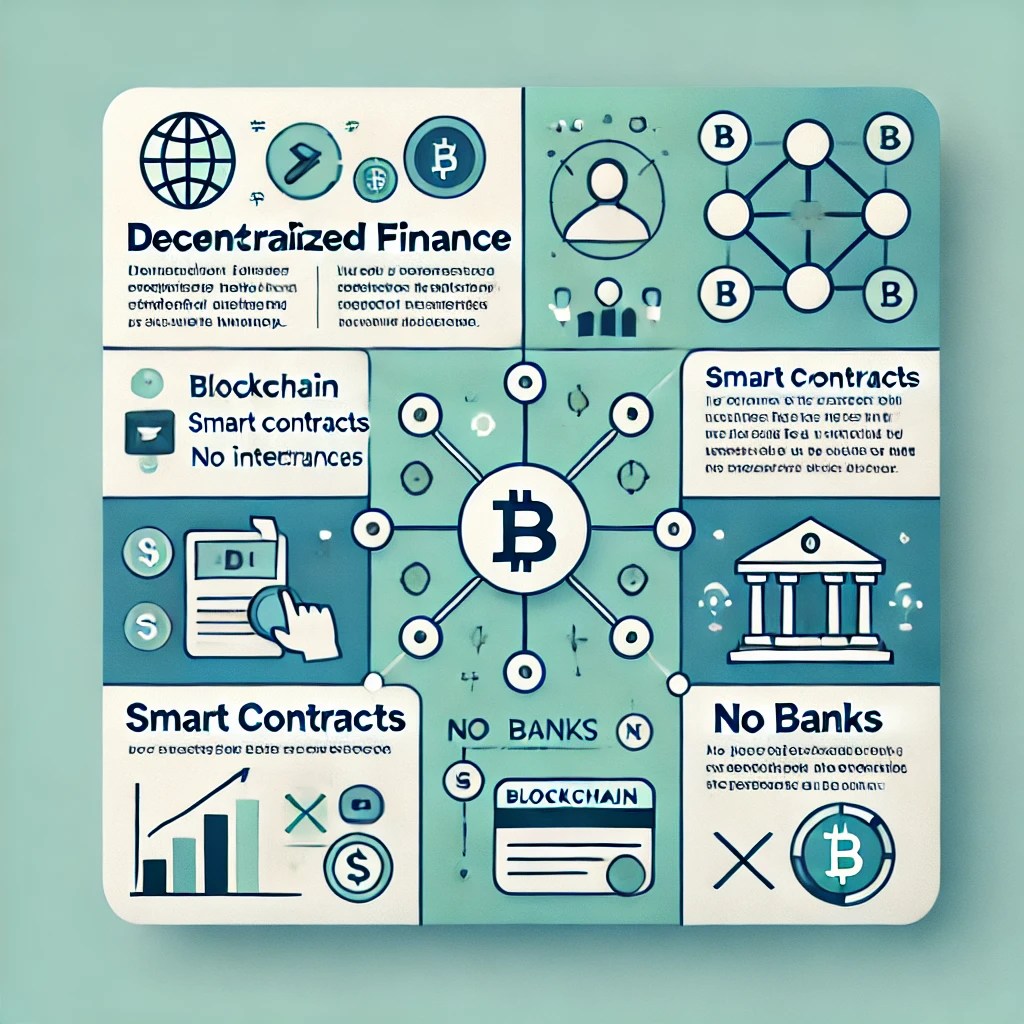
Decentralized Finance (DeFi):
A blockchain-based form of finance that does not rely on central financial intermediaries like banks, instead using smart contracts on blockchain networks.
Example: Platforms like Uniswap and Aave allow users to lend, borrow, and trade cryptocurrencies without traditional bank involvement.
Decentralized Identity:
A system allowing individuals to create and manage their digital identities without relying on a central authority.
Example: Self-sovereign identity solutions on blockchain enable users to control their personal data and share only what’s necessary.
Delegation (in PoS):
The act of assigning your tokens to a validator in a Proof of Stake system to help secure the network and earn rewards without running a validator node yourself.
Example: Cardano holders can delegate their ADA to a stake pool to earn staking rewards.
Derivative:
A financial contract whose value is based on an underlying asset, such as a cryptocurrency.
Example: Bitcoin futures and options are derivatives that allow traders to speculate on Bitcoin’s future price without owning the actual cryptocurrency.
Deterministic Wallet:
A cryptocurrency wallet that generates addresses and private keys from a single seed, allowing for easy backup and recovery.
Example: HD wallets (Hierarchical Deterministic) generate predictable wallet addresses from a master seed phrase.
Difficulty Adjustment:
The automatic mechanism that adjusts the complexity of mining based on total network computational power to maintain consistent block times.
Example: Bitcoin’s difficulty adjustment occurs every 2,016 blocks to maintain a 10-minute average block time.
Difficulty:
A measure of how hard it is to mine a block in a blockchain network, adjusting automatically to maintain consistent block times.
Example: Bitcoin’s mining difficulty increases when more miners join the network, ensuring blocks are produced approximately every 10 minutes.
Digital Asset:
A non-tangible asset that exists in digital form, including cryptocurrencies, tokens, and NFTs.
Example: Bitcoin, Ethereum tokens, and CryptoPunks NFTs are all considered digital assets.
Digital Signature:
A mathematical mechanism that verifies the authenticity and integrity of a digital message or document, used to confirm cryptocurrency transactions.
Example: When sending Bitcoin, your wallet creates a digital signature using your private key to prove you authorized the transaction.
Digital Wallet:
An electronic application that allows users to store, send, and receive cryptocurrencies.
Example: MetaMask is a popular digital wallet for storing Ethereum and other ERC-20 tokens.
Distributed Ledger:
A database that is consensually shared, replicated, and synchronized across multiple sites, institutions, or geographies.
Example: Blockchain is one type of distributed ledger technology used by most cryptocurrencies.
Double Spending:
A potential problem in digital currencies where the same digital token is spent more than once, something blockchain technology was designed to prevent.
Example: Bitcoin’s consensus mechanism prevents double spending by requiring network confirmation before transactions are considered valid.
Dust:
Very small amounts of cryptocurrency that are often uneconomical to transact with due to transaction fees.
Example: “I have some dust in my wallet—just 0.0000012 BTC that isn’t worth the fees to send.”
E
Ethereum Improvement Proposal (EIP):
A document proposing new features or processes for the Ethereum network, similar to Bitcoin’s BIP system.
Example: EIP-1559 introduced a new fee market to the Ethereum network, changing how transaction fees work.
Elliptic Curve Cryptography (ECC):
A type of cryptography used in many blockchain systems for generating key pairs, offering strong security with relatively small keys.
Example: Bitcoin uses a specific elliptic curve algorithm called secp256k1 for its cryptographic operations.
ERC-20:
A technical standard for tokens issued on the Ethereum blockchain, defining a common set of rules and functions that an Ethereum token must implement.
Example: Many popular tokens like USDT, USDC, and LINK are ERC-20 tokens built on Ethereum.
ERC-721:
A standard for non-fungible tokens on the Ethereum blockchain, allowing for unique, one-of-a-kind tokens that cannot be interchanged equivalently.
Example: Most Ethereum-based NFT collections use the ERC-721 standard.
ERC-1155:
A token standard on Ethereum that allows for both fungible and non-fungible tokens within the same smart contract, enabling more efficient and flexible token management.
Example: Some gaming platforms use ERC-1155 to represent both unique items (NFTs) and in-game currencies (fungible tokens) in a single contract.
Escrow:
A third-party arrangement where funds are held until certain conditions are met, often implemented in cryptocurrency transactions using smart contracts.
Example: In a peer-to-peer crypto exchange, an escrow smart contract holds the seller’s cryptocurrency until the buyer’s payment is confirmed.
Ethereum:
A blockchain platform that enables smart contracts and decentralized applications (dApps), with its native cryptocurrency called Ether (ETH).
Example: Many NFT projects and DeFi applications are built on the Ethereum blockchain.
Ethereum Virtual Machine (EVM):
The runtime environment for smart contracts on Ethereum, processing and executing code across the distributed network.
Example: Developers write smart contracts in languages like Solidity, which are then compiled to bytecode that runs on the EVM.
Exchange:
A platform where users can buy, sell, and trade cryptocurrencies.
Example: Coinbase, Binance, and Kraken are popular cryptocurrency exchanges.
F
Faucet:
A website or application that distributes small amounts of cryptocurrency for free, typically used for testing or to introduce new users to a cryptocurrency.
Example: Testnet faucets provide free test coins for developers to experiment with blockchain applications without using real money.
Fiat Currency:
Government-issued currency not backed by a commodity, such as US Dollars or Euros.
Example: When you buy Bitcoin with US Dollars, you’re exchanging fiat currency for cryptocurrency.
Fiat On-Ramp:
A service or platform that allows users to exchange fiat currency for cryptocurrency.
Example: Coinbase acts as a fiat on-ramp by allowing users to purchase cryptocurrencies with USD, EUR, and other fiat currencies.
Finality:
The point at which a transaction can no longer be reversed or altered, and is permanently recorded on the blockchain.
Example: Bitcoin transactions achieve practical finality after 6 confirmations, though theoretical reorgs remain possible.
Flash Loan:
A type of uncollateralized loan in DeFi where cryptocurrency is borrowed and repaid within the same transaction block.
Example: A trader might use a flash loan to take advantage of arbitrage opportunities between different exchanges or protocols.
Flippening:
A hypothetical scenario where Ethereum’s market cap surpasses Bitcoin’s, becoming the largest cryptocurrency by market capitalization.
Example: “The flippening didn’t happen during the last bull market, but Ethereum enthusiasts believe it might occur in the future.”
Floor Price:
The lowest price at which an NFT from a particular collection is listed for sale on marketplaces.
Example: “The floor price for Bored Ape Yacht Club NFTs is currently 80 ETH.”
Fork:
A split in a blockchain that creates two separate versions, either as a soft fork (backward-compatible) or a hard fork (creating a new cryptocurrency).
Example: Bitcoin Cash was created as a hard fork from Bitcoin in 2017.
FOMO (Fear Of Missing Out):
The anxiety or apprehension that one might miss an opportunity, particularly in cryptocurrency markets when prices are rising rapidly.
Example: “FOMO drove many new investors to buy cryptocurrencies at peak prices during the 2021 bull run.”
FUD (Fear, Uncertainty, and Doubt):
A strategy to influence perception by disseminating negative and dubious information, often used to manipulate cryptocurrency markets.
Example: “The price dropped after FUD about potential regulatory crackdowns spread through social media.”
Fungible:
A property of an asset where individual units are interchangeable and each unit is identical in value and function to any other.
Example: Bitcoin is fungible because any 1 BTC is equal to any other 1 BTC, unlike NFTs which are non-fungible.
Futures:
Financial contracts obligating the buyer to purchase an asset or the seller to sell an asset at a predetermined future date and price.
Example: Bitcoin futures allow investors to speculate on Bitcoin’s future price without holding the actual cryptocurrency.
G
Gas:
A fee paid to miners on the Ethereum network for including transactions in blocks, measured in Gwei.
Example: During network congestion, gas fees can spike, making small Ethereum transactions economically unfeasible.
Gas Limit:
The maximum amount of gas a user is willing to spend on an Ethereum transaction.
Example: Setting an appropriate gas limit ensures your transaction has enough computational resources to complete without wasting fees.
Gas Price:
The amount of Ether a user is willing to pay for each unit of gas, typically denominated in Gwei.
Example: During network congestion, users might set higher gas prices to prioritize their transactions.
Genesis Block:
The first block of a blockchain, hardcoded into the protocol and has no reference to a previous block.
Example: Bitcoin’s genesis block was mined by Satoshi Nakamoto on January 3, 2009.
Governance Token:
A cryptocurrency that gives holders voting rights on proposed changes to a protocol or platform.
Example: UNI token holders can vote on Uniswap improvement proposals and protocol changes.
Gwei:
A denomination of Ether, where 1 Gwei equals 0.000000001 ETH (one billionth of an Ether), commonly used to specify gas prices.
Example: “The current gas price is 25 Gwei, which is relatively low compared to peak periods.”
H
Halving:
A scheduled reduction in the block reward for a cryptocurrency, typically programmed to occur at regular intervals.
Example: Bitcoin’s block reward is cut in half approximately every four years, with the most recent halving occurring in 2020.
Hard Cap:
The maximum amount of funds a cryptocurrency project aims to raise during a token sale or ICO.
Example: “The project has set a hard cap of $20 million for their token sale.”
Hard Fork:
A permanent divergence from the previous version of a blockchain that requires all nodes and users to upgrade to the latest version of the protocol software. Non-upgraded nodes cannot process or validate new transactions.
Example: Ethereum’s transition from Proof of Work to Proof of Stake (The Merge) was implemented through a hard fork.
Hard Wallet:
A physical device that securely stores cryptocurrency offline, protecting it from online hacks.
Example: Ledger Nano X and Trezor are popular hardware wallet brands.
Hash:
A fixed-length output produced by a hash function from variable-length input data, used to verify data integrity in blockchains.
Example: Every block in a blockchain contains the hash of the previous block, creating a chain of blocks that ensures data integrity.
Hash Function:
An algorithm that converts data of any size into a fixed-size output (hash), with slight changes to input data producing drastically different outputs.
Example: Bitcoin uses the SHA-256 hash function for its proof-of-work mining process.
Hash Rate:
The speed at which a computer can perform cryptographic calculations, typically used in mining cryptocurrencies.
Example: A higher hash rate means more computational power and potentially more mining rewards.
Hierarchical Deterministic (HD) Wallet:
A wallet that generates a hierarchical tree-like structure of private/public key pairs from a single seed, allowing for better organization and backup.
Example: Most modern cryptocurrency wallets are HD wallets, allowing users to back up all their addresses with a single seed phrase.
HODL:
A misspelling of “hold” that became a popular term meaning to keep cryptocurrency long-term, regardless of market volatility.
Example: “I’m going to HODL my Bitcoin through this market downturn.”
Hot Wallet:
A cryptocurrency wallet that is connected to the internet, allowing for quick access but potentially more vulnerable to hacking.
Example: Exchange wallets and mobile wallets like Trust Wallet are hot wallets because they’re online and readily accessible.
I
Initial Coin Offering (ICO):
A fundraising method where new cryptocurrency projects sell tokens to investors.
Example: EOS raised over $4 billion through its ICO in 2018.
IDO (Initial DEX Offering):
A token sale conducted on a decentralized exchange (DEX) directly to the public, often more accessible than traditional ICOs.
Example: “The new project is launching via an IDO on PancakeSwap next week.”
Immutable:
The property of being unchangeable, a key characteristic of blockchain records once they have been confirmed.
Example: Once a Bitcoin transaction has received enough confirmations, it becomes immutable and cannot be reversed.
Index Fund (Crypto):
An investment fund that holds a portfolio of cryptocurrencies designed to track the performance of a specific market index.
Example: A crypto index fund might hold BTC, ETH, and other top cryptocurrencies weighted by market capitalization.
Initial Exchange Offering (IEO):
A token sale conducted directly through a cryptocurrency exchange, which typically vets the projects before listing.
Example: Binance Launchpad hosts IEOs for new cryptocurrency projects.
Initial Stake Pool Offering (ISPO):
A fundraising method where investors delegate their cryptocurrency to a project’s stake pool, earning the project’s tokens instead of the regular staking rewards.
Example: “The new Cardano project is raising funds through an ISPO, where ADA holders delegate to their stake pool.”
Interoperability:
The ability of different blockchain systems to exchange and make use of information.
Example: Projects like Polkadot and Cosmos aim to create interoperability between different blockchains (Cross-Chain Bridge).
K
KYC (Know Your Customer):
A process by which businesses verify the identity of their clients, required by many cryptocurrency exchanges to comply with regulations.
Example: To open an account on Coinbase, users must complete KYC verification by providing identification documents.
L
Layer 0:
The foundational infrastructure upon which Layer 1 blockchains can be built, focusing on interoperability between blockchains.
Example: Polkadot can be considered a Layer 0 blockchain, allowing for custom Layer 1 parachains to be built on top of it.
Layer 1:
The base blockchain protocol, such as Bitcoin or Ethereum, that processes and finalizes transactions on its own blockchain.
Example: Bitcoin, Ethereum, and Solana are all Layer 1 blockchain networks.
Layer 2:
A secondary framework or protocol built on top of an existing blockchain to improve its scalability and efficiency.
Example: Lightning Network is a Layer 2 solution for Bitcoin that enables faster and cheaper transactions.
Ledger:
A record-keeping system for financial transactions, with blockchains being a specific type of distributed ledger.
Example: The Bitcoin blockchain serves as a public ledger of all Bitcoin transactions ever made.
Leverage:
Using borrowed funds to increase the potential return of an investment in cryptocurrency, amplifying both gains and losses.
Example: A trader using 10x leverage would gain 10% if the price increases by 1%, but would also lose 10% if the price decreases by 1%.
Lightning Network:
A Layer 2 payment protocol built on top of the Bitcoin blockchain that enables faster and cheaper transactions through payment channels.
Example: Using the Lightning Network, users can make small Bitcoin payments with minimal fees and near-instant confirmation.
Liquidity:
The ease with which a cryptocurrency can be bought or sold without causing a significant change in its price.
Example: Bitcoin has high liquidity because it can be traded in large volumes without drastically affecting its market price.
Liquidity Mining:
A process where cryptocurrency holders provide assets to liquidity pools in exchange for rewards, typically in the form of governance tokens.
Example: “I’m earning UNI tokens through liquidity mining by providing ETH and USDC to a Uniswap pool.”
Liquidity Pool:
A collection of funds locked in a smart contract, used to facilitate decentralized trading, lending, and other financial activities.
Example: Uniswap uses liquidity pools to enable users to trade tokens without traditional order books.
Liquidity Provider (LP):
An individual or entity that contributes assets to a liquidity pool in a decentralized exchange or protocol.
Example: Liquidity providers on Uniswap earn trading fees in proportion to their share of the pool.
M
Mainnet:
The fully developed and deployed version of a blockchain where actual transactions take place and have real economic value.
Example: “The project is migrating from testnet to mainnet next month, meaning tokens will have real value.”
Market Cap:
The total value of a cryptocurrency, calculated by multiplying its current price by the total number of coins in circulation.
Example: Bitcoin’s market cap often exceeds $500 billion.
Market Maker:
An individual or entity that places limit orders to buy and sell assets, providing liquidity and narrowing the bid-ask spread in markets.
Example: Professional market makers help ensure cryptocurrency exchanges maintain liquid markets with tight spreads.
Maximum Supply:
The maximum number of coins or tokens that will ever exist for a particular cryptocurrency.
Example: Bitcoin has a maximum supply of 21 million coins, creating digital scarcity.
MEV (Maximal Extractable Value):
The profit that can be extracted from blockchain users by reordering, including, or excluding transactions within blocks.
Example: Flash bots and front-running attacks are common methods used to extract MEV from blockchain networks.
Mempool:
A waiting area for unconfirmed cryptocurrency transactions before they are added to the blockchain.
Example: During high network congestion, transactions with low fees may remain in the mempool for extended periods.
Merkle Tree:
A data structure used in blockchain to efficiently verify the contents of large data sets, summarizing all transactions in a block.
Example: Bitcoin uses Merkle trees to efficiently organize transaction data within each block.
MetaMask:
A popular browser extension and mobile app that serves as an Ethereum wallet and gateway to blockchain applications.
Example: Users can connect MetaMask to decentralized applications to interact with smart contracts and manage their Ethereum assets.
Mining:
The process of validating and adding new transactions to a blockchain, typically involving solving complex mathematical problems.
Example: Bitcoin miners use powerful computers to solve cryptographic puzzles and earn Bitcoin rewards.
Mining Pool:
A group of cryptocurrency miners who combine their computational resources to increase their chances of finding a block and earning rewards.
Example: F2Pool and Antpool are large mining pools where thousands of miners work together to mine Bitcoin.
Mining Rig:
A specialized computer system designed specifically for mining cryptocurrencies.
Example: A Bitcoin mining rig might consist of multiple ASIC miners connected to a power supply and cooling system.
Minting:
The process of validating information, creating a new block, and recording that information onto the blockchain, or creating new tokens or NFTs.
Example: Artists mint NFTs by creating digital tokens that represent ownership of their artwork on the blockchain.
Moon/Mooning:
Slang term referring to a cryptocurrency rapidly increasing in value, “going to the moon.”
Example: “Bitcoin is mooning!” might be exclaimed when its price increases dramatically in a short period.
Multi-signature (Multisig):
A security feature requiring multiple private keys to authorize a cryptocurrency transaction, rather than a single signature.
Example: A corporate Bitcoin wallet might use multisig requiring 3 out of 5 executives to approve withdrawals.
N
Node:
A computer or server that participates in a blockchain network by maintaining a copy of the blockchain and, in some cases, validating transactions.
Example: Running a Bitcoin full node helps secure the network by validating and relaying transactions.
Non-custodial:
A type of cryptocurrency service or wallet where users maintain control of their private keys and, consequently, their funds.
Example: MetaMask is a non-custodial wallet as it gives users full control of their private keys and funds.
NFT (Non-Fungible Token):
A unique digital asset representing ownership of a specific item or piece of content on the blockchain.
Example: Digital art pieces sold on platforms like OpenSea are often NFTs.
O
Off-chain:
Transactions or processes that occur outside of the blockchain but may still be connected to blockchain assets.
Example: Lightning Network transactions occur off-chain and are only settled on the Bitcoin blockchain when a payment channel is closed.
On-chain:
Activities that take place directly on the blockchain and are recorded in the distributed ledger.
Example: Standard Bitcoin transactions are on-chain, requiring network confirmations and paying miner fees.
Open Source:
Software whose source code is publicly available, allowing anyone to inspect, modify, or enhance it.
Example: Bitcoin’s codebase is open source, enabling transparency and community contributions to its development.
Oracle:
A service that provides real-world data to blockchains and smart contracts, bridging the gap between blockchain and external systems.
Example: Chainlink oracles provide price feed data to DeFi platforms, enabling accurate token swaps and loans.
OTC (Over-the-Counter):
Trading that occurs directly between two parties without the supervision of an exchange.
Example: Large Bitcoin transactions are often conducted OTC to avoid moving the market price on exchanges.
P
Paper Wallet:
A physical document containing printed copies of a cryptocurrency wallet’s public and private keys.
Example: Some users create paper wallets as a form of cold storage by printing their private keys and storing them in a safe.
Peer-to-Peer (P2P):
A decentralized communication model where parties interact directly with each other without a central server or authority.
Example: Bitcoin transactions are peer-to-peer, allowing users to send funds directly to each other without intermediaries.
Permissioned Blockchain:
A blockchain where access is restricted to authorized participants, controlled by one or more entities.
Example: Hyperledger Fabric is a permissioned blockchain often used by enterprises for private business networks.
Permissionless Blockchain:
A blockchain that anyone can join and participate in, without needing approval from a central authority.
Example: Bitcoin is a permissionless blockchain, allowing anyone to run a node or mine without requiring permission.
Phishing:
A fraudulent attempt to obtain sensitive information such as passwords or private keys by disguising as a trustworthy entity.
Example: Crypto users may receive fake emails pretending to be from exchanges asking them to “verify” their wallet details.
Private Key:
A secret alphanumeric code that allows access to cryptocurrency holdings, used to sign transactions and prove ownership.
Example: The private key to a Bitcoin wallet must be kept secure, as anyone with access to it can control the associated funds.
Proof of Authority (PoA):
A consensus mechanism that relies on a set of approved validators to create new blocks in a blockchain.
Example: VeChain uses a Proof of Authority consensus where authority nodes are known entities with verified identities.
Proof of Stake (PoS):
A consensus mechanism where validators are chosen to create new blocks based on the number of coins they “stake” or lock up as collateral.
Example: Ethereum switched to a Proof of Stake model in 2022.
Proof of Work (PoW):
A consensus mechanism where miners compete to solve complex mathematical problems to validate transactions and create new blocks.
Example: Bitcoin uses Proof of Work as its consensus mechanism.
Protocol:
A set of rules that govern how data is exchanged and processed within a blockchain network.
Example: The Bitcoin protocol specifies how transactions are validated, blocks are created, and consensus is achieved.
Public Key:
A cryptographic code shared publicly and used to receive cryptocurrency, derived from but not revealing the private key.
Example: A Bitcoin address is derived from a public key and can be safely shared with others to receive funds.
Pump and Dump:
A scheme where a group artificially inflates the price of a cryptocurrency (pump) before selling their holdings at the higher price (dump).
Example: Some Telegram groups coordinate pump and dump schemes on low-volume altcoins to profit at the expense of unsuspecting investors.
Q
QR Code:
A two-dimensional barcode that can be scanned with a smartphone to quickly access a cryptocurrency address.
Example: Many cryptocurrency wallets generate QR codes representing public addresses to facilitate easier transfers.
R
Rebase/Rebasing:
An automatic adjustment of a cryptocurrency’s total supply to achieve a target price or functionality.
Example: Ampleforth is a rebasing cryptocurrency that adjusts its supply daily based on demand to target a stable value.
Relative Strength Index (RSI):
A technical analysis indicator that measures the speed and magnitude of price movements to evaluate overbought or oversold conditions.
Example: Traders might sell when a cryptocurrency’s RSI exceeds 70, indicating potentially overbought conditions.
Recovery Phrase:
A series of words (typically 12 or 24) that can be used to recover a cryptocurrency wallet and its associated private keys.
Example: “Please write down your 24-word recovery phrase and store it in a secure location.”
Relative Strength Index (RSI):
A technical analysis indicator that measures the speed and change of price movements, used to identify overbought or oversold conditions.
Example: Traders might sell when a cryptocurrency’s RSI exceeds 70, indicating it may be overbought.
Rollup:
A Layer 2 scaling solution that processes transactions off the main blockchain but posts transaction data back to the main chain.
Example: Optimistic and zk-rollups on Ethereum increase transaction throughput while maintaining the security of the main chain.
ROI (Return on Investment):
A performance measure used to evaluate the efficiency of an investment, calculated by dividing the profit by the cost.
Example: “My ROI on Bitcoin since 2020 has been over 300%.”
Rugpull:
A scam where cryptocurrency developers abandon a project and run away with investors’ funds.
Example: Many small, unregulated DeFi projects have been known to perform rugpulls.
S
Satoshi:
The smallest unit of Bitcoin, equal to 0.00000001 BTC (one hundred millionth of a Bitcoin), named after Bitcoin’s creator.
Example: “That’ll cost you 500 satoshis” is a way of referring to a small fraction of a Bitcoin.
Satoshi Nakamoto:
The pseudonymous person or group who created Bitcoin and published the Bitcoin whitepaper in 2008.
Example: Despite numerous claims and investigations, the true identity of Satoshi Nakamoto remains unknown.
Scalability:
The ability of a blockchain network to handle an increasing amount of transactions and users efficiently.
Example: Bitcoin’s Lightning Network is a solution aimed at improving Bitcoin’s scalability by enabling faster and cheaper transactions.
Scam Token:
A fraudulent cryptocurrency created with the intention to steal investor funds.
Example: Many scam tokens create websites that mimic legitimate projects to trick investors into purchasing worthless coins.
Seed Phrase:
A series of words that can be used to access a cryptocurrency wallet, also known as a recovery phrase or mnemonic phrase.
Example: “Never share your seed phrase with anyone, as it provides complete access to your wallet.”
Segregated Witness (SegWit):
A Bitcoin protocol upgrade that separates signature data from transaction data, increasing the network’s transaction capacity.
Example: SegWit was implemented in Bitcoin in 2017 to help address scaling issues.
Sharding:
A blockchain scaling technique that partitions a network into smaller pieces (shards) to process transactions in parallel.
Example: Ethereum’s roadmap includes sharding to dramatically increase network capacity and reduce fees.
Shilling:
Aggressively promoting a cryptocurrency, often for personal gain and without disclosing financial interests.
Example: “That influencer is shilling low-cap altcoins to his followers without mentioning he’s being paid to promote them.”
Shitcoin:
A pejorative term for cryptocurrencies perceived to have little to no value or use case.
Example: “Most of the thousands of tokens created during the 2017 ICO boom turned out to be shitcoins with no utility.”
Short/Shorting:
Borrowing a cryptocurrency to sell it, with the intention of buying it back later at a lower price and profiting from the price decrease.
Example: “When the market looked overheated, I decided to short Bitcoin at $60,000 and closed the position at $40,000.”
Sidechain:
A separate blockchain that runs parallel to the main blockchain, with a two-way peg that allows assets to be transferred between them.
Example: The Liquid Network is a Bitcoin sidechain that enables faster and more private transactions for traders and exchanges.
Slippage:
The difference between the expected price of a cryptocurrency trade and the actual price at which the trade executes.
Example: “When I tried to swap a large amount of tokens on a DEX with low liquidity, I experienced 5% slippage.”
Smart Contract:
Self-executing contracts with the terms directly written into code, automatically executing when predetermined conditions are met.
Example: Decentralized lending platforms use smart contracts to automatically issue and manage loans.
Soft Fork:
A backward-compatible upgrade to a blockchain protocol where only previously valid blocks/transactions are made invalid. Non-upgraded nodes will continue to process transactions as long as they follow the new rules.
Example: The SegWit upgrade in Bitcoin was implemented as a soft fork, allowing non-upgraded nodes to continue operating on the network.
Solidity:
A programming language designed for developing smart contracts that run on the Ethereum Virtual Machine.
Example: Most smart contracts on Ethereum are written in Solidity, including those used for popular DeFi applications.
Stablecoin:
A cryptocurrency designed to maintain a stable value, often pegged to a fiat currency like the US Dollar.
Example: Tether (USDT) and USD Coin (USDC) are popular stablecoins.
Staking:
The process of actively participating in transaction validation on a Proof of Stake blockchain by locking up a certain amount of cryptocurrency.
Example: Ethereum holders can stake their ETH to earn rewards while helping to secure the network.
Staking Pool:
A group of coin holders who combine their resources to increase their chances of being rewarded for validating blocks.
Example: “I joined a Cardano staking pool since I don’t have enough ADA to run my own validator profitably.”
State Channel:
A Layer 2 scaling solution where participants can conduct multiple transactions off-chain, only settling the final state on the main blockchain.
Example: Bitcoin’s Lightning Network uses state channels to enable fast, low-fee transactions that are only settled on the main chain when channels are closed.
Swap:
The exchange of one cryptocurrency for another, typically through a decentralized exchange.
Example: “I used Uniswap to swap some of my ETH for USDC without using a centralized exchange.”
T
Testnet:
A separate blockchain used for testing purposes, allowing developers to experiment without using real cryptocurrency.
Example: Bitcoin’s testnet allows developers to test new wallet features without risking actual Bitcoin.
Token:
A digital asset created on an existing blockchain, representing various types of value or utility.
Example: Many tokens are created on the Ethereum blockchain using the ERC-20 standard.
Token Economy:
The economic system governing how a token is created, distributed, and used within a blockchain ecosystem.
Example: “The project’s token economy includes staking rewards, governance rights, and fee sharing for token holders.”
Token Burn:
The process of permanently removing cryptocurrency tokens from circulation by sending them to a wallet address from which they can never be retrieved.
Example: Some projects burn tokens regularly to reduce supply and potentially increase value.
Token Standard:
A set of rules and functions that tokens on a particular blockchain must implement for compatibility.
Example: ERC-20, ERC-721, and ERC-1155 are popular token standards on the Ethereum blockchain.
Total Supply:
The total amount of a cryptocurrency that will ever exist, including all coins currently in circulation and those yet to be released.
Example: Bitcoin has a total supply cap of 21 million coins.
TPS (Transactions Per Second):
A measure of a blockchain’s throughput, indicating how many transactions it can process each second.
Example: “While Bitcoin processes around 7 TPS, Solana claims to handle over 50,000 TPS under optimal conditions.”
Trading Bot:
An automated program that trades cryptocurrencies according to predefined strategies and algorithms.
Example: Many professional traders use trading bots to execute strategies 24/7 without emotion or fatigue.
Transaction Fee:
A small amount paid to miners or validators to process and confirm a cryptocurrency transaction.
Example: Ethereum transaction fees (called “gas fees”) can vary based on network congestion.
Transaction Hash (TXID):
A unique identifier assigned to every cryptocurrency transaction, used to track its status on the blockchain.
Example: You can look up a transaction hash on a block explorer to check if your transaction has been confirmed.
Treasury:
A fund of tokens controlled by a project’s team or DAO, used for development, marketing, and other expenses.
Example: “The DAO voted to allocate 1 million tokens from the treasury to fund new protocol upgrades.”
Trustless:
A system that operates correctly and securely without relying on a trusted third party, a fundamental aspect of blockchain technology.
Example: Bitcoin’s trustless system allows users to transact directly without needing to trust each other or an intermediary.
U
Uniswap:
A popular decentralized exchange protocol on Ethereum that uses automated market makers instead of order books.
Example: “I used Uniswap to swap ETH for a new token that isn’t listed on centralized exchanges yet.”
Unspent Transaction Output (UTXO):
An output of a blockchain transaction that can be spent in the future, used in Bitcoin and some other cryptocurrencies.
Example: Bitcoin wallets calculate your balance by summing all UTXOs associated with your addresses.
Utility Token:
A cryptocurrency designed to provide access to a specific product or service within an ecosystem.
Example: “The BNB token has utility for paying reduced fees on the Binance exchange.”
V
Validator:
A participant in a Proof of Stake blockchain who is responsible for verifying transactions and maintaining consensus.
Example: Ethereum validators must stake 32 ETH to participate in block validation and earn rewards.
Volatility:
The degree of variation in a trading price over time, with cryptocurrencies often exhibiting high volatility.
Example: Bitcoin’s price can experience double-digit percentage changes within a single day, demonstrating its high volatility.
W
Wallet:
A digital tool that allows users to store, send, and receive cryptocurrencies.
Example: MetaMask, Trust Wallet, and Exodus are popular cryptocurrency wallets.
Wallet Address:
A unique string of alphanumeric characters that serves as a destination to send cryptocurrency, derived from a public key.
Example: “Please send the Bitcoin to wallet address 1A1zP1eP5QGefi2DMPTfTL5SLmv7DivfNa.”
Wash Trading:
The process of buying and selling the same cryptocurrency to create artificial trading volume and manipulate prices.
Example: “Some cryptocurrency exchanges engage in wash trading to appear more liquid and attract new users.”
Web3:
The concept of a new iteration of the World Wide Web based on blockchain technology, emphasizing decentralization and token-based economics.
Example: Web3 applications like decentralized social media platforms aim to give users ownership over their data and content.
Whale:
An individual or entity that holds a large amount of a particular cryptocurrency.
Example: A Bitcoin whale might own thousands of bitcoins, capable of significantly impacting market prices.
Whitepaper:
A document issued by a cryptocurrency project that explains its technology, purpose, and tokenomics.
Example: The Bitcoin whitepaper, published by Satoshi Nakamoto in 2008, outlined the first blockchain-based cryptocurrency.
Wrapped Token:
A token pegged to the value of another cryptocurrency but compatible with a different blockchain.
Example: “WBTC (Wrapped Bitcoin) allows Bitcoin holders to participate in Ethereum-based DeFi protocols.”
Y
Yield:
The return earned on cryptocurrency holdings through various means such as staking, lending, or providing liquidity.
Example: “By providing liquidity to a stablecoin pair, I’m earning a 15% annual yield in trading fees and reward tokens.”
Yield Farming:
A practice where cryptocurrency holders provide liquidity to DeFi protocols in exchange for rewards, often in the form of additional tokens.
Example: Users can earn yield by depositing their tokens into liquidity pools on platforms like Curve or Balancer.
Z
Zero-Knowledge Proof:
A cryptographic method that allows one party to prove to another that a statement is true without revealing any additional information.
Example: “zk-rollups use zero-knowledge proofs to verify transactions on Ethereum while maintaining privacy and reducing gas costs.”
ZK-SNARK:
Zero-Knowledge Succinct Non-Interactive Argument of Knowledge; a specific type of zero-knowledge proof used in cryptocurrencies like Zcash.
Example: “Zcash uses ZK-SNARKs to enable users to shield transaction amounts and addresses from public view while still verifying their validity.”
Sign up for email!
Thank you for your response. ✨

 Crypto Term
Leave a comment